

7 Essential POS Agent Documents in Nigeria
Nigeria’s POS industry has expanded rapidly as more people rely on local agents for withdrawals, transfers, bill payments, and cash deposits. According to data from the Nigeria Inter-Bank Settlement System (NIBSS), POS transaction volumes continue to rise yearly, especially in underserved communities where bank branches are limited. That growth has created opportunities for thousands of Nigerians looking for stable small-business income.
Becoming a POS Agent is no longer just about owning a machine. Banks and fintech companies now require proper documentation, identity verification, and compliance checks before approving agents. Many applicants get rejected because they submit incomplete documents or misunderstand the onboarding process.
Understanding the exact requirements before applying can save time, money, and unnecessary frustration. Whether you want to operate from a kiosk, a retail shop, or a roadside stand, knowing the right documents and setup process gives you a stronger chance of approval and long-term success.
Table of Contents
Why POS Business Is Growing Fast in Nigeria
The POS business has become one of Nigeria’s most visible small-business opportunities because millions of people still struggle with reliable banking access. In many towns and rural communities, the nearest bank branch may be several kilometers away. POS agents bridge that gap by providing quick financial services close to customers.
Digital banking adoption has also increased demand. Nigerians now transfer money, pay bills, and receive payments more frequently through mobile banking apps. However, cash remains important for transportation, food purchases, and local market transactions. POS agents help people convert digital money into physical cash quickly.
Several fintech companies have simplified entry into the industry. Providers like Moniepoint, Opay, PalmPay, and banks now recruit agents aggressively across Nigeria. This expansion creates opportunities for entrepreneurs with small startup capital.

Key reasons the industry continues growing include:
- Increased cash withdrawal demand during banking network failures
- Rising smartphone and mobile banking usage
- Limited rural banking infrastructure
- Faster financial inclusion across underserved communities
- Flexible startup options for small entrepreneurs
- Daily transaction-based income opportunities
The growth potential remains strong because many communities still lack sufficient POS coverage. Agents who choose good locations and maintain customer trust often build steady daily income streams.
Essential Documents Every POS Agent Must Have
Every POS provider in Nigeria requires identity and business verification before approving a POS Agent application. These requirements help reduce fraud and comply with Central Bank of Nigeria regulations.
The first essential document is a valid government-issued ID card. Most providers accept a National Identification Number slip, voter’s card, international passport, or driver’s license. Your name on the ID must match your bank account details to avoid verification problems.
A Bank Verification Number (BVN) is also mandatory. BVN verification helps fintech companies confirm identity and financial records. Applications with mismatched BVN information are frequently rejected during onboarding.
Most providers also require proof of address. This may include utility bills, tenancy agreements, or official documents showing your location. Rural applicants without utility bills may use alternative verification depending on the provider.
Additional required documents usually include:
- Passport photographs for account verification
- Active phone number linked to BVN
- Business location photographs
- CAC registration documents for larger operations
- Valid bank account details
- Guarantor information in some cases
Applicants should prepare digital and physical copies of all documents before beginning registration. Missing paperwork can delay approval for several weeks.
Why KYC Verification Matters
KYC, which means Know Your Customer, is one of the biggest parts of POS registration. Financial companies must verify every agent’s identity to reduce fraud, money laundering, and fake account activities.
Strong KYC verification also builds trust between customers and POS operators. Customers feel safer using agents whose identities are properly registered with recognized providers.
What Is the Most Important Requirement for a POS Agent?
A valid identity profile supported by accurate KYC information is the most important requirement for becoming a POS Agent in Nigeria. Even if you have startup capital, fintech companies may reject your application if your records contain inconsistencies.
Identity Consistency Is Critical
Many Nigerian applicants unknowingly use different names across documents. For example, a BVN may contain “Oluwatayo Adebayo” while the NIN shows “Adebayo Oluwatayo Samuel.” These differences often trigger verification delays.
Before applying, ensure:
- Your BVN matches your ID documents
- Your phone number is linked properly
- Your bank account details are active
- Your address details are accurate
Business Location Verification
Most providers now inspect or verify business locations before releasing terminals. This helps reduce fraudulent registrations and abandoned devices.
Even if you operate from a kiosk or roadside stand, your location should:
- Be visible and accessible
- Have stable customer traffic
- Provide basic security
- Allow clear branding visibility
Reliable identification combined with a stable business location significantly increases approval chances.
How to Register as a POS Agent Successfully
Becoming a POS Agent involves more than filling out an online form. A successful registration process requires planning, proper documentation, and choosing the right provider.
Step 1: Choose a POS Provider
Different providers offer different commission structures, withdrawal charges, and onboarding requirements. Research multiple options before deciding.
Popular providers in Nigeria include:
- Moniepoint
- Opay
- PalmPay
- Baxi
- Firstmonie
- Paga
Step 2: Prepare Your Documents
Scan or photograph all documents clearly before submission. Blurry uploads are one of the biggest causes of delays.
Step 3: Submit Your Application
Applications are usually completed online or through agent representatives. Some providers also conduct interviews or physical inspections.
Step 4: Wait for Verification
Verification may take several days depending on the provider. Rural applicants sometimes experience longer processing periods.
Step 5: Receive Training and Terminal
Approved applicants usually receive onboarding guidance, transaction instructions, and fraud prevention education before activation.
A careful registration process reduces rejection risks and helps agents begin operations smoothly.
What Are the Best Locations for a POS Agent Business?

Location can determine whether a POS business succeeds or struggles. High-traffic areas with limited banking services usually perform best.
Busy markets remain excellent choices because traders frequently need quick withdrawals and transfers. Transport parks also generate strong transaction volumes since passengers often require cash.
Rural communities with few bank branches can be highly profitable for agents willing to provide consistent service. Many successful agents operate in villages where residents depend heavily on POS services for everyday transactions.
Strong POS business locations include:
- Open markets
- School environments
- Bus parks
- Residential estates
- Rural communities
- Areas near ATMs with long queues
Avoid Oversaturated Areas
Some urban locations already contain too many agents competing for the same customers. Excess competition can reduce profits and increase price wars.
Before choosing a location:
- Observe daily foot traffic
- Count nearby POS operators
- Check electricity availability
- Test mobile network strength
Good positioning often matters more than expensive shop decorations.
What documents do I need to become a POS Agent?
To become a POS Agent in Nigeria, you typically need a valid government-issued ID, BVN, passport photograph, proof of address, active bank account, and phone number linked to your BVN. Some providers may also request CAC registration documents, business location photos, or guarantor details depending on the type of account and transaction volume expected.
After submitting these documents, fintech companies verify your identity through KYC procedures before approving your application. Applicants with consistent records and accurate information usually receive faster approval.
The registration process becomes easier when all documents are prepared ahead of time. Organizing both digital and printed copies can prevent delays during onboarding.

Common Reasons POS Agent Applications Get Rejected
Many applicants assume approval is automatic once they submit documents. However, fintech companies reject thousands of applications due to verification and compliance problems.
Incorrect BVN Information
BVN mismatches are one of the biggest causes of rejection. Names, dates of birth, and phone numbers must align across all records.
Poor Business Location
Providers may reject applications from unsafe or inactive areas. Locations without stable transaction potential are considered risky.
Fake or Edited Documents
Submitting altered documents can permanently blacklist an applicant from certain providers. Always use genuine and updated records.
Weak Internet or Network Coverage
POS services depend heavily on mobile connectivity. Areas with unstable network access may experience approval difficulties.
Incomplete Application Forms
Small mistakes such as missing phone numbers or incomplete addresses can delay verification significantly.
Avoiding these mistakes increases approval chances and creates a smoother onboarding process.
Pro Tips to Succeed as a POS Agent
Successful POS operators focus on customer trust, consistency, and smart financial management instead of only chasing transaction volume.
One important strategy is maintaining enough cash flow daily. Agents who frequently run out of cash lose customer confidence quickly. Monitoring transaction patterns helps predict busy periods and cash needs.
Another valuable tip is building relationships with nearby traders and residents. Customers return to agents who provide reliable service, polite communication, and fast transactions.
Strong operational habits include:
- Keeping transaction records daily
- Using multiple network SIM cards
- Monitoring fraud alerts carefully
- Maintaining stable electricity backup
- Avoiding unnecessary transfer disputes
Agents should also diversify services by offering airtime sales, bill payments, and account opening assistance where possible.
Common Mistakes to Avoid with POS Agent Registration
Ignoring KYC Accuracy
Many applicants rush through onboarding forms without checking details carefully. Small spelling errors can trigger verification failures.
Choosing Bad Business Locations
Some agents select areas based only on cheap rent instead of customer demand. Poor visibility reduces transaction opportunities.
Depending on One Provider
Relying entirely on one provider creates operational risk during network failures or downtime.
Neglecting Security Measures
POS operators handling large daily cash volumes should prioritize security, especially in isolated areas.
Poor Customer Service
Rude communication and slow dispute resolution can damage reputation quickly.
Avoiding these common mistakes improves long-term business sustainability.
Best Tools for POS Agent Business

Moniepoint POS
Reliable fintech terminal with strong rural penetration. Pricing varies depending on onboarding conditions. Widely used across Nigeria.
Opay POS
Known for aggressive agent expansion and simplified onboarding. Accessible for small-scale operators.
PalmPay POS
Offers transaction services and merchant support with growing market presence.
Ledger Book Apps
Free bookkeeping apps help agents track daily profits, expenses, and transfers accurately.
Power Banks and Mini UPS
Essential backup tools for areas with unstable electricity supply.
Network Testing Apps
Useful for identifying strong mobile signal providers before choosing a business location.
People Also Ask About POS Agent
Can I become a POS agent without a shop?
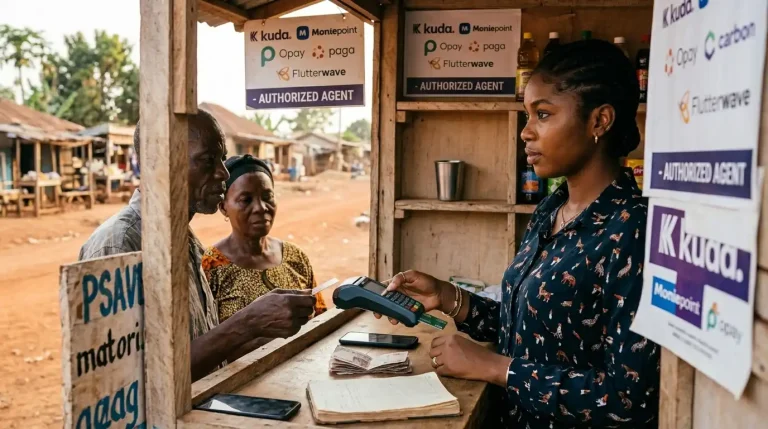
Yes. Many Nigerian POS agents operate successfully from kiosks, roadside stands, or shared retail spaces. What matters most is visibility, security, and customer traffic rather than owning a large shop.
Which bank gives POS machine easily in Nigeria?
Several fintech providers and banks offer relatively simple onboarding, including Moniepoint, Opay, PalmPay, and Firstmonie. Approval still depends on meeting KYC and documentation requirements.
How much does it cost to start a POS business?
Startup costs vary depending on provider, location, and setup. Many small operators begin with ₦50,000–₦300,000 including cash float, branding, and accessories.
Is CAC registration compulsory for POS business?
Not always. Small individual agents can operate without CAC registration under some providers, but larger businesses may require formal registration.
FAQ About POS Agent
Do I need a shop before becoming a POS Agent?
No. Many providers allow agents to operate from kiosks, shared spaces, or roadside stands as long as the location is secure and accessible.
Can students become POS agents in Nigeria?
Yes. Students with valid identification, BVN, and a stable operating location can apply successfully.
How long does POS Agent approval take?
Approval timelines vary by provider. Some applications are approved within days, while others may take several weeks due to verification checks.
Can I use multiple POS machines?
Yes. Many experienced operators use multiple providers to reduce downtime during network issues.
Is the POS business profitable in rural areas?
Rural areas often perform well because banking access is limited. Agents serving underserved communities may experience steady daily demand.
Final Thoughts on Becoming a POS Agent
The POS Agent business continues to create opportunities for Nigerians seeking flexible income sources and small-business growth. However, success starts with proper preparation. Having the right documents, accurate KYC details, and a strategic location improves approval chances significantly.
Applicants who understand verification requirements usually avoid delays and unnecessary rejection. Beyond registration, long-term success depends on customer trust, reliable service, and smart financial management.
As Nigeria’s fintech ecosystem expands, demand for accessible financial services will likely continue growing in both urban and rural communities. Agents who stay professional and organized position themselves for sustainable growth.
Explore more practical business and digital finance guides on Bloog.ng and share your POS business experience in the comments section.